GPT-5.4 vs Claude Sonnet 5.5 vs Gemini 4 Argon: A Practical Model Comparison
A dated, source-linked comparison of three widely available frontier APIs: context, published token pricing, modalities, and where each fits. No invented parameter counts or misleading one-number benchmark rankings.
By Chakri AI Research

There is no universal “best model.” For a product team, the useful comparison is practical: what does the API accept, how much context does it hold, what does a typical request cost, and how reliably does it complete your own task? This snapshot compares three current models listed on OpenRouter, checked on November 18, 2026.
At a glance
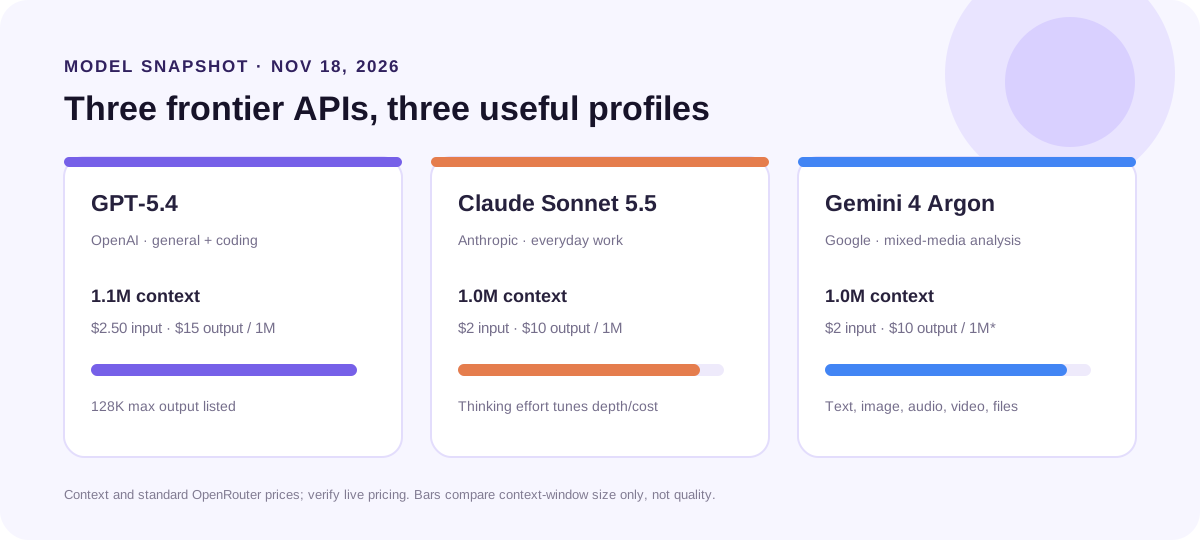
| Model (OpenRouter ID) | Context window | Input / output per 1M tokens | Inputs / notable controls | Best starting point |
|---|---|---|---|---|
| OpenAI GPT-5.4 openai/gpt-5.4 | 1.1M tokens (922K input + 128K output) | $2.50 / $15.00 | Text and images; tool use | General-purpose apps and coding where you need broad capabilities |
| Anthropic Claude Sonnet 5.5 anthropic/claude-sonnet-5.5 | 1.0M tokens (up to 128K output) | $2.00 / $10.00 | Text, images, PDFs; tools; thinking always on, effort controls depth/cost | Everyday coding, fixes, and document work |
| Google Gemini 4 Argon google/gemini-4-argon | 1.0M tokens (up to 1M output) | $2.00 / $10.00* | Text, images, audio, video, files; tool use | Large mixed-media inputs and multi-step technical analysis |
*OpenRouter lists Gemini 4 Argon at $2/$10 per million for standard routing on the checked date and also shows a limited-time 50% discount. The table uses the displayed standard rate, not the promotional rate. GPT-5.4’s OpenRouter page lists a separate lower-cost Flex route; table prices use Standard providers.
What the comparison does—and does not—tell you
Context size is a capacity ceiling, not a quality score. A million-token window can hold a large repository or a long evidence pack, but retrieval quality, prompt organization, latency, and total input cost still matter. Try representative tasks at the size you expect to ship.
A model’s benchmark score is only meaningful with the benchmark name, version, test setup, and date. Company-published scores are not a clean head-to-head unless the same benchmark and evaluation conditions were used. We therefore do not collapse different vendor-reported scores into a pretend “winner” score here.
Choose by task, then run your own small eval
| If your workload is… | Start by trying… | Measure before you choose |
|---|---|---|
| A coding assistant or multi-step tool workflow | GPT-5.4 and Claude Sonnet 5.5 | Task completion, tool-call correctness, regressions, latency, and cost per accepted result |
| Long documents with charts, PDFs, audio, or video | Gemini 4 Argon | Evidence recall, citations/grounding, supported media formats, and total request cost |
| High-volume chat or extraction | All three, plus smaller models | Quality at your error threshold; cache hit rate; p95 latency; input/output token mix |
| Privacy or regional constraints | Provider-specific routes available to you | Data handling terms, storage controls, residency, retention, and provider availability |
Build a small evaluation set from real examples (including edge cases), score outputs against a rubric, and review failures manually. Estimate the bill from actual token usage: one million input tokens and one million output tokens are billed separately, and generated output can dominate the cost even when input is cheap.
OpenRouter is a convenient comparison and routing layer, but the serving provider and route can affect performance and price. For production, pin or constrain providers when consistency, region, or data controls matter, and recheck model pages before setting a budget.
Sources and further reading
- OpenRouter: GPT-5.4
- OpenRouter: Claude Sonnet 5.5
- OpenRouter: Gemini 4 Argon
- OpenAI model release
- Anthropic: Claude Sonnet 5.5
- Google Gemini
Specifications and prices can change. Check the linked pages before making a purchasing or deployment decision.