AI and the Future of Jobs: What Karpathy, Ng, and the Evidence Actually Suggest
A grounded guide for job seekers: separate task automation from job loss, understand the expert debate, and build skills that travel across changing roles.
By Chakri Career Research
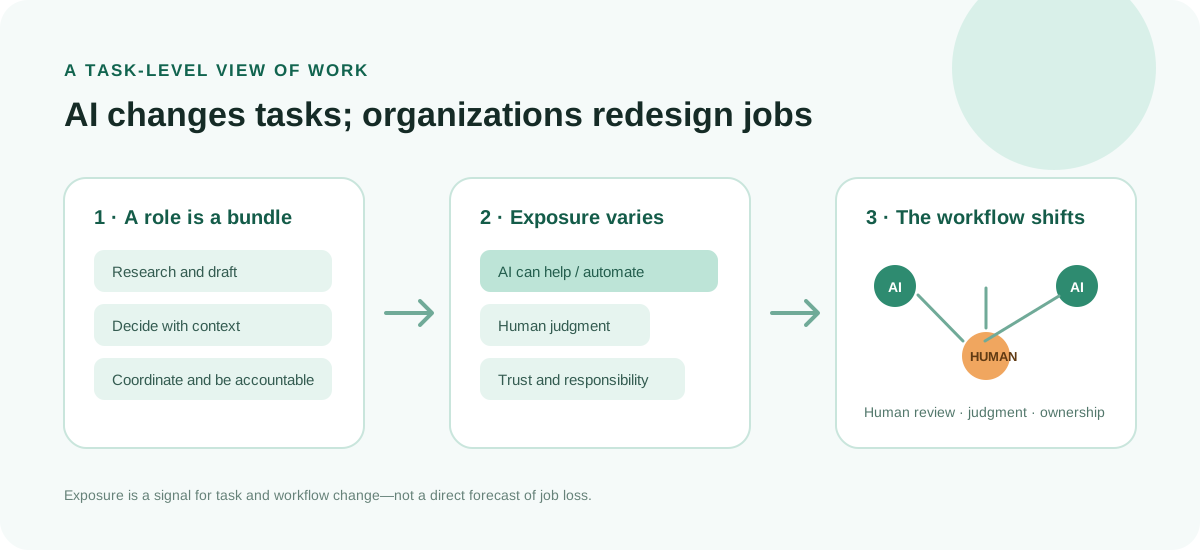
“Will AI take my job?” is too broad to answer honestly. A job is a bundle of tasks: some can be sped up or automated, while others depend on context, trust, physical work, accountability, or human relationships. The job market then responds through hiring, redesign, wages, new products, and policy—not just a one-for-one swap of a person for a model.
What leading AI voices emphasize
Andrej Karpathy’s June 2025 keynote “Software Is Changing (Again)” is useful for software workers because it focuses on the changing shape of software creation and the way people direct AI systems. It is a practitioner’s account of a fast-moving craft, not a statistical forecast that a particular share of jobs will vanish.
Andrew Ng’s career advice takes a builder’s view: learn enough AI to find a useful problem, make a small working solution, and build domain expertise around it. His practical point is that AI capability creates opportunities for people who can apply it in real workflows, even when “AI engineer” is not their job title.
These perspectives are valuable, but neither should be mistaken for labor-market measurement. Leaders can explain emerging tools and work patterns; employment data is needed to see whether hiring, job quality, and wages are changing at scale.
What early labor-market evidence says
Anthropic’s March 2026 study created an “observed exposure” measure by combining task feasibility with real usage data, weighting work-related automation more heavily. Its authors found no systematic rise in unemployment among the most exposed US occupations since late 2022, alongside suggestive evidence that hiring of 22–25 year olds may have slowed in exposed occupations. They also stress limits: the measure uses one platform’s usage and early data cannot settle future effects.
The ILO’s 2025 global task-level analysis similarly frames generative AI as more likely to transform many jobs than eliminate them outright, while noting that clerical work has higher exposure and impacts differ by gender and country income. “Transform” can still mean hard transitions, fewer entry-level openings, changed pay, or work intensification, so it is not a guarantee that every worker benefits.
| Question | What it can tell us | What it cannot tell us alone |
|---|---|---|
| Can a model perform or speed up this task? | Technical exposure and possible workflow gains | Whether a company will deploy it or trust it |
| Is AI already used for this task at work? | Adoption signal in a specific dataset or product | A complete picture of all workers, firms, and countries |
| Are exposed workers being hired less? | A possible labor-market signal worth tracking | That AI caused the change, without careful comparison |
| Does a job contain many exposed tasks? | Where redesign pressure may be higher | Whether the role disappears; human tasks and demand may grow |
A useful plan for job seekers in Bangladesh
Build a T-shaped profile: one dependable domain skill, a working understanding of AI tools, and evidence that you can deliver an outcome. For a marketer, that might mean campaign analysis with AI-assisted research and a human-checked recommendation. For a developer, it might mean a tested feature with documented trade-offs, security checks, and an explanation of what the AI generated.
Practise the full loop: define the user problem, choose a tool, provide good context, review the result, test it, and explain what changed. Keep a short portfolio of before-and-after work with your own contribution and verification steps clearly marked. This makes your skill visible even as tool names change.
No serious source can promise that a particular occupation is safe or doomed. Track the tasks employers are changing, learn the tools that fit your domain, and keep strengthening judgment, communication, and accountability. These are ways to adapt—not guarantees against economic disruption.
Sources and further reading
- Anthropic: Labor market impacts of AI (Mar 2026)
- Andrej Karpathy: Software Is Changing (Again), AI Startup School keynote
- Andrew Ng: Finding Your First AI Job
- OpenAI: Jobs in the Intelligence Age (Sep 2025)
- ILO: Generative AI and jobs (2025 update)
Specifications and prices can change. Check the linked pages before making a purchasing or deployment decision.